


Three Card Poker Strategy Essential Guide to Smarter Play Decisions
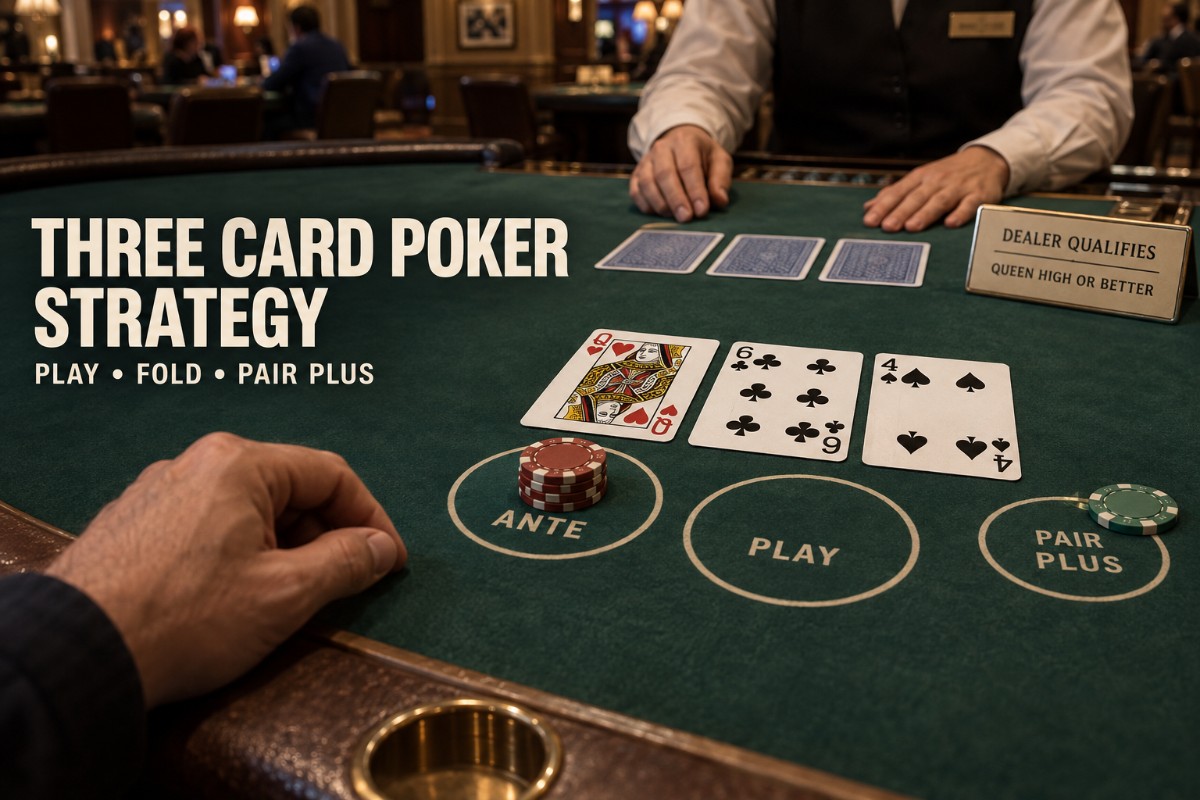
Three card poker strategy starts with understanding that the game is not played like ordinary multi-player poker. You compete against the dealer with only three cards, and the main decision comes after seeing your hand. At that point, you either continue by matching your Ante with a Play wager or fold and give up the Ante.
The game also offers separate side bets, but those should not be confused with the main contest against the dealer. A useful approach is to learn the ranking of three-card poker hands, understand dealer qualification, and know exactly how Ante and Play are settled before adding optional wagers.
How the main game begins
To enter the main game, you place an Ante before the cards are dealt. You then receive three cards face up, while the dealer receives three cards face down. After seeing your cards, you decide whether to fold or place a Play wager equal to the original Ante.
This decision is the core of three card poker strategy because folding ends your participation immediately, while continuing exposes the additional Play stake. Evolution’s current live rules state that the dealer needs Queen-high or better to qualify. If the dealer does not qualify, the Play wager pushes and the Ante pays 1:1.
For a broader look at related formats, see the casino card games guide. When using Gembet, check the current table help section because payout tables, side bets and limits can vary between versions.
Understanding Ante and Play
Ante and Play work together but are placed at different times. The Ante gets you into the round. The Play wager is made only after you see your three cards and choose to continue. If you fold, the Ante is lost and no Play wager is made.
If the dealer qualifies, your hand is compared with the dealer’s hand. When your hand ranks higher, both Ante and Play normally pay 1:1 under Evolution’s current rules. If the dealer has the better hand, both wagers lose. If the hands tie, both wagers push.
This is why a sound three card poker strategy focuses first on whether continuing is justified. The decision is not about guessing the dealer’s exact cards, but comparing your known hand with the threshold where continuing becomes mathematically preferable to folding.
Why dealer qualification matters
Dealer qualification changes how the main wagers settle. Evolution currently requires the dealer to hold Queen-high or better. If the dealer has less than Queen-high, the dealer does not qualify, the Play wager is returned, and the Ante wins at 1:1.
This rule matters because you are not simply trying to make a traditional poker hand such as a pair or straight. Some high-card combinations can still be strong enough to justify continuing because the dealer qualification threshold is relatively modest.
A sound approach therefore treats the dealer qualifying rule as part of the main-game structure, not as a bonus condition. The dealer failing to qualify can produce a different settlement from an ordinary head-to-head comparison.
How three-card poker hands are ranked
The ranking of three-card poker hands differs slightly from five-card poker because the probabilities are different with only three cards. In standard Three Card Poker, a straight ranks above a flush. The common order from highest to lowest is straight flush, three of a kind, straight, flush, pair and high card.
Understanding these hand rankings prevents one of the easiest beginner mistakes: assuming five-card poker rankings transfer perfectly. A straight is harder to make than a flush with three cards, which is why its ranking is higher in this game.
The dealer and player use the same ranking system in the main comparison. A practical approach should therefore start with recognising the hand correctly before considering whether to continue.
What the Pair Plus bet does
The Pair Plus bet is optional and is settled independently of the dealer’s hand. Evolution states that it wins when the player’s three cards make a pair or better. You do not need the dealer to qualify, and the dealer does not need to lose the main game for the side wager to pay.
The Pair Plus bet can win while the main game loses, or the main game can win while the side wager loses. Treating them as separate wagers makes the total amount at risk much easier to understand.
The casino side bets guide can help explain why optional wagers should be evaluated separately rather than automatically added to every round.
Do side bets improve the main-game decision?
No. The Pair Plus side wager does not change the cards you receive or the dealer qualifying rule. It simply adds another wager that is settled from the player’s hand. The same is true of the optional Six Card Bonus offered on Evolution’s live version.
If a player has already placed the Pair Plus bet, the main decision should still be made according to the strength of the three-card hand and the correct main-game strategy. A side bet that happens to be winning does not turn a weak main hand into a stronger one.
One useful three card poker strategy habit is to calculate the full round cost before betting begins. The Ante, optional side bets and possible Play wager can make the final exposure much larger than the first chip placed on the table.
Why Queen-high is an important reference point
Because the dealer qualifies at Queen-high, many players assume any Queen-high hand should automatically be played. That is too simplistic. Basic strategy for this game is usually described with a more precise threshold based on the player’s exact three cards rather than the dealer’s qualification rule alone.
The qualifying threshold explains settlement, while the decision threshold tells the player whether continuing is mathematically preferable. Those are related concepts, but they are not identical.
This distinction is another reason the exact three cards should be read carefully. A Queen-high hand can contain different kickers, and those extra cards can matter when deciding whether to fold or place the Play wager.
Why one common strategy threshold is often cited
Authoritative mathematical analysis of Three Card Poker commonly identifies Queen-6-4 as the basic play-or-fold threshold for the standard Ante game. In simplified terms, hands at or above that threshold are played, while weaker hands are folded, subject to the exact rules of the table.
This does not guarantee that a hand at the threshold will beat the dealer. It means the expected result of continuing is better than folding under the analysed rules. Three card poker strategy is therefore about reducing avoidable decision errors, not predicting the dealer’s cards.
Always use a strategy source that matches the current game. Rule changes, payout changes or additional features can affect the mathematics.
Ante bonuses are separate from dealer qualification
Evolution’s current rules also provide an Ante Bonus for a straight or better, provided the player has made the Play wager. The bonus is based on the player’s hand and is paid regardless of the value of the dealer’s hand.
This means the dealer does not need to qualify for the Ante Bonus to apply. It also shows why learning three-card poker hands matters beyond the basic win-or-lose comparison: some stronger hands can trigger an additional payout condition.
Do not confuse the Ante Bonus with the Pair Plus side wager. One belongs to the main-game structure, while the other is an optional side wager placed before the cards are dealt.
Manage the total stake, not only the Ante
A small Ante can make the game look inexpensive until the other possible wagers are included. If the Ante is S$5, continuing requires another S$5 Play wager. Adding a S$5 Pair Plus bet means the round can involve S$15 of total exposure before any other side wager is considered.
Good three card poker strategy includes choosing a base stake that remains comfortable if you continue. The possibility of placing both main wagers in the same round should be part of the budget from the beginning.
Side bets should have their own limit. Large advertised payouts do not make the qualifying hands more likely to appear.
A clearer way to approach the game
Three card poker strategy is most useful when the game is broken into separate decisions. First, place the Ante only at a stake you can afford. Next, identify your hand correctly. Then decide whether to fold or continue with Ante and Play according to a strategy source that matches the current rules.
Keep the Pair Plus side wager separate in your thinking and remember that the dealer qualifying rule changes settlement without predicting whether your hand will win. Side bets can add variety, but they also increase total exposure.
Three card poker strategy cannot guarantee a winning session. It can, however, help you avoid confusing five-card rankings with three-card poker hands, understand when the dealer qualifies, and make the main Play-or-fold decision from a consistent mathematical framework rather than instinct.
Experience the real deal with SG's top Live Dealers. Play Baccarat, Roulette & more.

