


Asian Handicap Betting Strategy Essential Guide to Smarter Football Lines
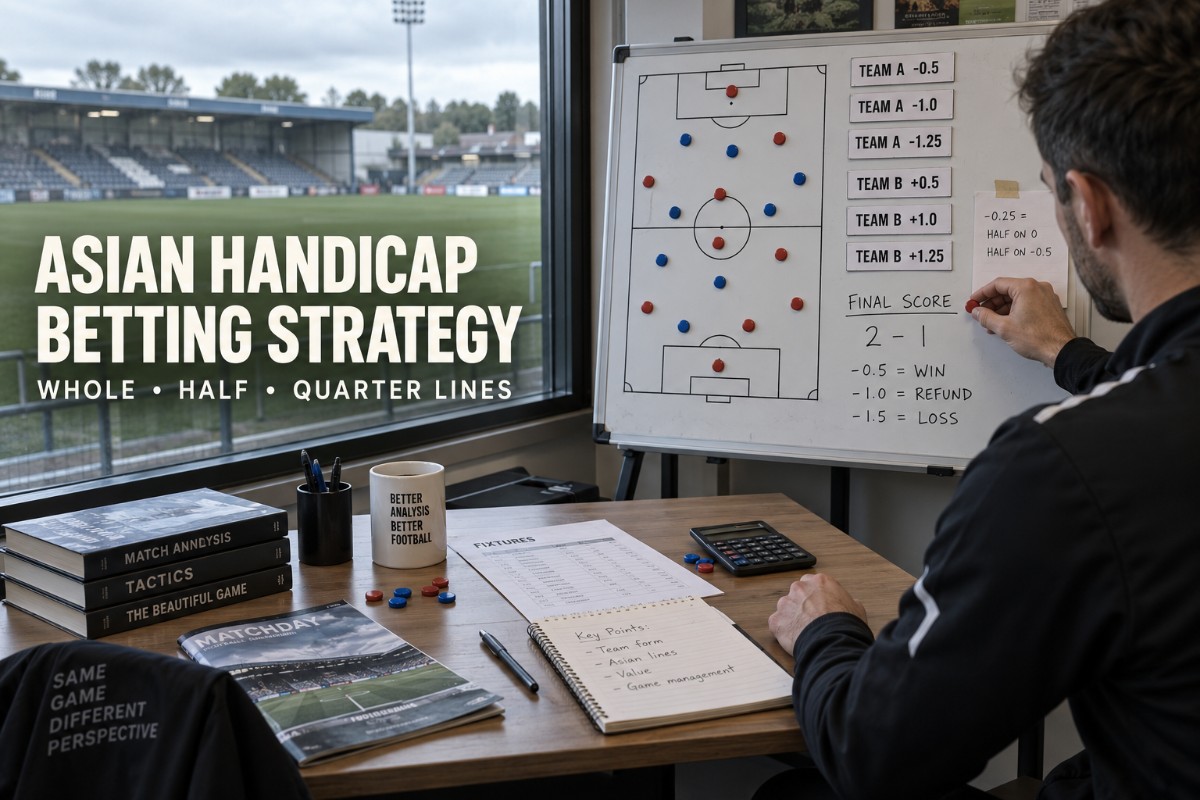
Asian handicap betting strategy starts with understanding that the market adjusts one team’s score before settlement. Instead of choosing home, draw or away in a standard three-way market, this market usually reduces the match to two betting options by giving one side a virtual advantage or disadvantage.
The key is reading the handicap line correctly. A favourite may start at -0.5, -1.0 or -1.25, while the underdog receives the corresponding positive number. A half-goal handicap always creates a clear betting winner, while a quarter-goal handicap splits the stake across two neighbouring lines.
How the asian handicap market works
The asian handicap market applies a virtual goal adjustment before the bet is settled. If Team A is -1.5, it effectively starts one and a half goals behind for betting purposes. Team A must therefore win by at least two goals for that selection to win.
This structure removes the ordinary draw selection and creates a two-way market. Betfair explains that the purpose is to balance teams of different strengths while offering prices on both sides of the same handicap line.
For a broader look at football wagering options, see the sportsbook football markets guide. When using Gembet, check the exact market rules before placing the bet because settlement details can differ between pre-match and in-play markets.
Why the handicap line matters
The listed adjustment determines what result your selection actually needs. A team at -0.5 must win the match. A team at +0.5 can win or draw. A team at -1.0 usually needs to win by two or more goals for a full win, while a one-goal victory commonly produces a refund.
This is why asian handicap betting strategy should always begin with the number attached to the team, not simply with which side looks stronger. The same team can be attractive at -0.5 and far less appealing at -1.5 because the required winning margin has changed.
How a half-goal handicap is settled
A half-goal handicap uses lines such as +0.5, -0.5, +1.5 or -1.5. Because a football score cannot finish with half a goal, there is no push on the adjusted result.
If you back a favourite at -0.5, that team must win. If you back the underdog at +0.5, a win or draw is enough. At -1.5, the favourite needs a victory by at least two goals, while +1.5 allows the underdog to lose by one goal and still cover.
A clear asian handicap betting strategy therefore treats a half-goal handicap as a full win-or-loss decision. There is no refunded middle result on these lines.
What happens on whole-goal lines
Whole-goal lines include 0, +1, -1, +2 and -2. These can produce a push when the adjusted score finishes level. Betfair and bet365 both state that a zero handicap returns the stake when the actual match is drawn.
A -1.0 selection also creates a possible refund. If the chosen team wins by exactly one goal, the handicap produces an adjusted tie and the stake is normally returned. A win by two or more gives a full win, while a draw or defeat loses.
This makes the selected adjustment useful for controlling how much winning margin is required before the bet pays in full.
Why the zero line resembles draw no bet
A zero asian handicap market is effectively the same basic result structure as Draw No Bet. The selected team wins the bet if it wins the match, while an actual draw normally returns the stake.
That makes the zero line easier to understand than many other Asian lines. It can also be useful for comparing prices across equivalent markets before betting.
The draw no bet strategy guide explains the same win-refund-loss structure from the traditional sportsbook market perspective.
How a quarter-goal handicap works
A quarter-goal handicap uses numbers such as -0.25, +0.25, -0.75 and +0.75. The sportsbook effectively divides the stake equally between two neighbouring handicap lines.
For example, a S$20 wager at -0.25 is normally split into S$10 at 0 and S$10 at -0.5. If the team wins, both parts win. If the match is drawn, the zero portion is refunded while the -0.5 portion loses.
This is why a quarter-goal handicap can create half-win or half-loss settlements. The outcome is not mysterious once the split is understood; it is simply two related bets combined into one displayed line.
How -0.75 and +0.75 differ
A -0.75 line is commonly split between -0.5 and -1.0. If the favourite wins by two or more, both parts win. If it wins by exactly one, the -0.5 part wins while the -1.0 part is refunded, producing a half win.
On the other side, +0.75 is usually split between +0.5 and +1.0. If the underdog loses by exactly one goal, the +0.5 portion loses while the +1.0 portion is refunded, producing a half loss.
A disciplined asian handicap betting strategy should calculate these split outcomes before kickoff rather than trying to work them out after the final whistle.
This approach is especially useful when two teams are priced far apart in the ordinary match market. Instead of deciding only whether the favourite wins, the bettor evaluates how large the expected performance gap really is. That can make the market more precise, but it also means a correct prediction about the winner can still produce a losing handicap bet.
It also helps to compare several nearby prices. Moving from -0.5 to -1.0, for example, changes both the required result and the offered odds. A better price is not automatically better value if the additional condition is much harder to satisfy.
Why stronger favourites receive negative handicaps
Negative numbers are usually assigned to the stronger side because the market expects that team to outperform the opponent. The handicap makes the betting contest more balanced by requiring the favourite to win by a certain margin.
Positive handicaps do the opposite for the underdog. A team at +1.0 receives a one-goal virtual head start for settlement, while +1.5 gives an even larger cushion.
The asian handicap market therefore changes the question from “Who will win?” to “How will the team perform relative to this adjusted score?”
Do not choose the favourite just because the price looks fair
A common mistake is assuming the favourite is still the best selection after a large negative adjustment. The team may be very likely to win but much less likely to win by the margin required by the selected adjustment.
For example, a team priced strongly in the standard match market might still struggle to cover -1.5 against an organised defensive opponent. A narrow 1-0 win would be successful in the ordinary market but lose the handicap wager.
Asian handicap betting strategy should therefore separate match superiority from expected winning margin.
Use team style when judging the line
Some favourites regularly dominate matches but win by narrow margins. Others continue attacking after taking the lead and are more capable of covering larger negative lines. The opponent’s style matters as well.
A deep defensive side may make a heavy favourite work for every chance, while an open opponent can create a match with more scoring variance. Venue, injuries, schedule congestion and likely line-ups should all be considered before judging the asian handicap market.
The best use of historical results is to understand how teams tend to perform in similar match conditions, not to assume one past margin will repeat. Asian handicap betting strategy becomes more useful when those results are connected to opponent strength, venue and tactical approach.
How in-play Asian handicaps can differ
In-play rules deserve special attention because operators can frame settlement differently. Bet365 currently states that its in-play Asian Handicap effectively resets the score to 0-0 from the moment the bet is placed, while Betfair’s Exchange help says its in-play handicap is settled using the final score with the selected handicap applied.
That difference is important. Never assume the same displayed number means the same settlement method across every in-play product. Read the market description before confirming the stake.
A careful asian handicap betting strategy treats operator-specific in-play rules as part of the bet, not as a minor technical detail.
A clearer way to use Asian handicaps
Asian handicap betting strategy works best when the line is translated into a simple match requirement before any wager is placed. Know whether the team needs to win, avoid defeat, win by two, or simply stay within a certain margin.
Use the half-goal handicap when you want a clear win-or-loss settlement, understand how a quarter-goal handicap splits the stake, and remember that whole-goal lines can produce refunds. Those mechanics matter just as much as deciding which team is stronger.
The goal is not to find a handicap system that guarantees profit. It is to understand the adjusted score, compare the price with the expected winning margin, and keep the stake within a consistent budget. That makes the handicap line a clearer analytical tool instead of a confusing set of plus and minus numbers.
Experience the real deal with SG's top Live Dealers. Play Baccarat, Roulette & more.

