


Dragon Tiger Strategy Essential Guide to Smarter Card Bets
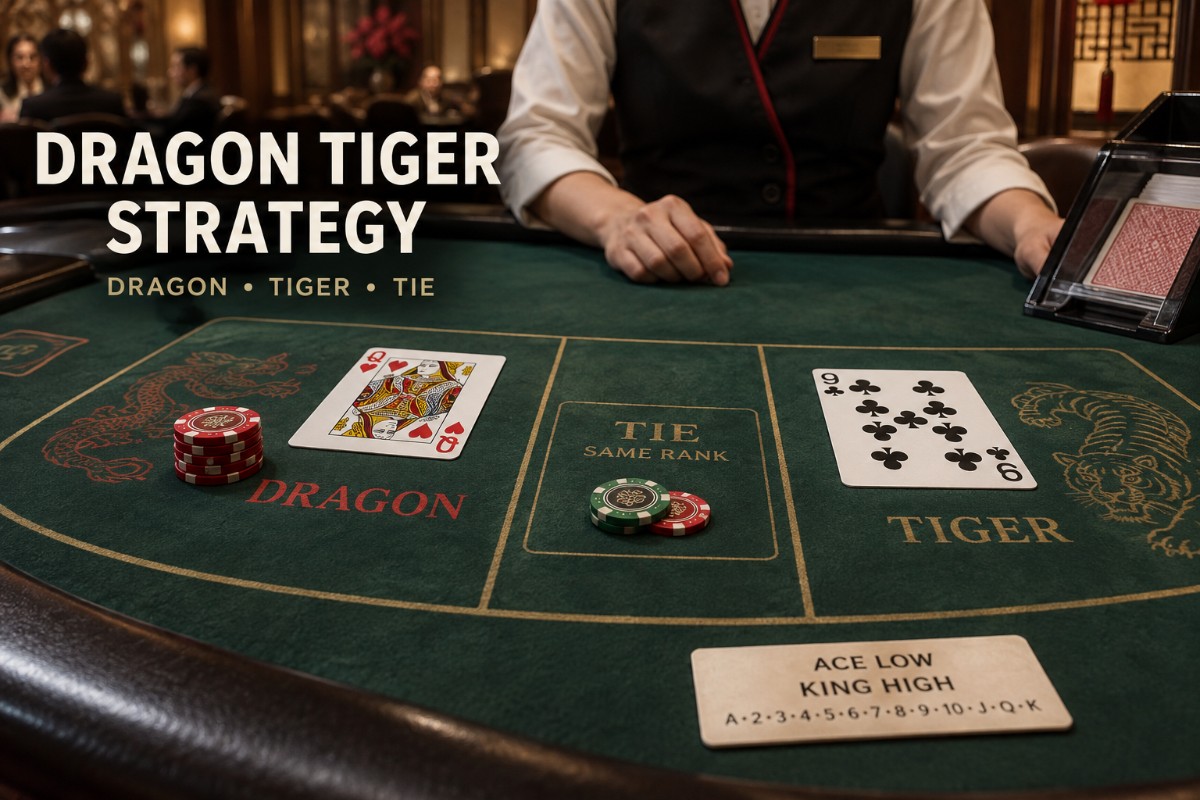
Dragon Tiger strategy starts with understanding how little information the player actually needs to process. One card is dealt to Dragon and one to Tiger, and the higher card wins. There is no drawing, standing or hand-building decision after the cards appear, so the main choices happen before the deal: Dragon bet, Tiger bet or Tie bet.
The game is often compared with baccarat because of its two-sided layout and fast rounds, but the comparison can be misleading if it causes players to import baccarat habits directly. Good Dragon Tiger rules knowledge is more useful than trying to read streaks, roads or recent card sequences as if they predict the next result.
How a standard round works
In the standard live version, one card is dealt to each side. Aces are low, followed by 2 through 10, then Jack, Queen and King as the highest rank. Suits do not change the ordinary Dragon-versus-Tiger comparison unless a separate suited tie wager is offered.
The player places a Dragon bet when expecting the Dragon card to rank higher and a Tiger bet when expecting the Tiger card to rank higher. If both cards have the same rank, the result is a tie. Evolution’s current standard game also offers a separate suited tie option when both rank and suit match.
For a broader comparison of the two games, see the Dragon Tiger versus baccarat guide. When using Gembet, check the current table information before betting because limits, side wagers and settlement details can vary by version.
Why the Dragon and Tiger sides are symmetrical
In the basic game, Dragon and Tiger are opposing positions with the same card-ranking system. Neither side receives an extra draw or special scoring advantage after the deal. This means the decision between the two main sides is much simpler than choosing between different blackjack actions or comparing multiple sports markets.
A useful Dragon Tiger strategy therefore does not assume that one named side is naturally stronger. The two main wagers are labels for opposite outcomes, not different tactical roles. Recent wins on one side do not change the card order on the next round.
That simplicity is one of the reasons the game moves quickly, but fast settlement also makes stake control important because many rounds can be played in a short period.
What happens when the cards tie
A Tie bet is a separate wager predicting that the two cards will have the same rank. Evolution currently lists the standard Tie payout at 11:1, while a suited tie pays 50:1. Those larger payouts reflect much narrower qualifying outcomes than choosing one of the two main sides.
How a tie affects an ordinary main-side wager depends on the rules of the version being played. This is an area where the help panel matters, because table variants can handle main-side ties differently. Do not assume a tie is automatically settled the same way across every provider.
Good Dragon Tiger rules reading means checking the exact main-bet settlement as well as the headline side-bet payout.
Why a large Tie payout does not make it a better prediction
A high payout can make the tie wager look attractive, but the advertised return does not make equal-ranked cards more likely to appear. It simply compensates for the fact that a tie is a much more specific outcome than one side receiving the higher card.
This is an important part of Dragon Tiger strategy because side bets often attract attention through large numbers. The right question is not whether 11:1 or 50:1 looks exciting. The question is what exact result must occur for that wager to win.
The same principle applies to any table game: potential payout and probability should be considered together rather than separately.
Do roadmaps predict Dragon Tiger outcomes?
Many live tables display previous outcomes in a roadmap or history panel. These records can show runs of Dragon, Tiger and ties, which makes them visually similar to baccarat roads. They are useful for showing what has already happened, but they do not force the next card to follow or reverse the pattern.
Backing Dragon does not become stronger because Tiger has won five times in a row. Likewise, backing Tiger does not become overdue after several Dragon wins. The next deal is not trying to balance the previous sequence.
The baccarat roadmaps guide explains why historical displays should be treated as records rather than prediction tools, and the same caution applies here.
Why card rank matters more than suit
Standard Dragon Tiger rules compare card rank first. An Ace is the lowest card and a King is the highest. A Queen beats a Jack, a 10 beats a 9, and so on. In the ordinary main game, a heart does not beat a club simply because of its suit.
Suit becomes relevant only when a specific side wager such as suited tie uses it as part of the winning condition. That distinction prevents another common beginner mistake: trying to rank suits in the main Dragon-versus-Tiger comparison.
Learning the simple rank order before placing any wager removes most confusion from settlement.
Do multiple decks change the basic decision?
Evolution’s current Lightning Dragon Tiger information states that the game uses eight standard 52-card decks without Jokers. Standard live Dragon Tiger is also presented as a shoe-based card game. Multiple decks affect the mathematical distribution of remaining cards, but they do not create a practical visual system that reliably predicts the next side from a short history panel.
Unless a player is using a validated advantage-play method under known rules and shoe conditions, Dragon Tiger strategy should not be built around guessing what card rank is due next.
For ordinary play, understanding the wager and payout is more reliable than making assumptions from a few visible past cards.
Keep the main wagers separate from side bets
A common mistake is treating the Tie bet as if it protects a Dragon bet or Tiger bet. It is a separate wager with its own stake and settlement. Adding it increases total money at risk for the round.
For example, S$5 on Dragon plus S$2 on Tie means S$7 is exposed, not S$5. If a suited tie option is added as well, total exposure increases again. Small side wagers can therefore make the round more expensive than it first appears.
A disciplined Dragon Tiger strategy adds up every chip before the deal rather than focusing only on the largest single wager.
Why chasing the opposite side is risky
After several Tiger wins, some players move to Dragon because they believe the sequence must reverse. Others keep betting Tiger because they believe the streak will continue. These are opposite reactions to the same historical information, and neither changes the next deal.
A Dragon bet should not be increased simply because Dragon has been absent for several rounds, and a Tiger bet should not be doubled because Tiger has been winning. The next round can still produce either side or a tie.
One of the simplest Dragon Tiger rules for bankroll control is to keep the stake tied to the session budget rather than recent results.
Why fast rounds can distort stake perception
Dragon Tiger can settle much faster than many card games because only two cards are dealt. That speed can make S$2 or S$5 wagers feel small in isolation while total turnover builds quickly over many rounds.
If a player makes twenty S$5 main wagers, S$100 has been staked across the session even though no single round looked large. Adding a Tie bet regularly increases turnover further.
A useful Dragon Tiger strategy is to set both a total session budget and a base stake before the first deal. That creates a clearer stopping point than trying to decide after a long sequence of quick rounds.
A clearer way to approach the game
Dragon Tiger strategy is most useful when it keeps a simple game simple. Learn the rank order, understand exactly how the table handles ties, and separate the main Dragon bet and Tiger bet from optional side wagers. Do not treat the roadmap as a forecasting tool.
Use Dragon Tiger rules to check settlement and payout details before betting, especially when switching between standard, speed or multiplier variants. A Tie bet can offer a larger return because it requires a narrower outcome, not because the game is signalling that a tie is due.
Dragon Tiger strategy cannot predict which side will receive the higher card. It can, however, help keep wagers understandable, prevent side bets from quietly increasing exposure, and reduce the temptation to chase streaks in a fast game where the next round begins almost immediately.
Experience the real deal with SG's top Live Dealers. Play Baccarat, Roulette & more.

