


Blackjack Insurance Strategy Essential Guide to Avoiding a Costly Side Bet
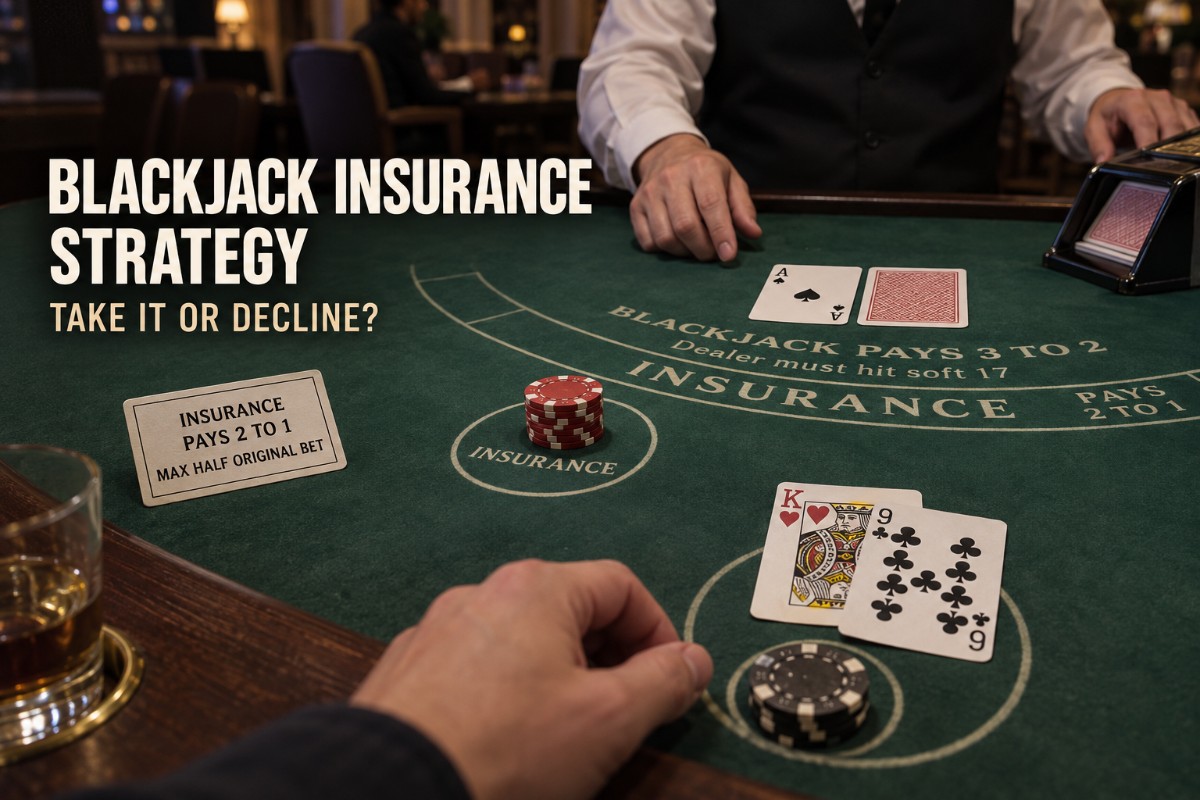
Blackjack insurance strategy starts with understanding what the insurance offer actually means. When the dealer shows an Ace, some tables let you place a separate side wager that the dealer’s hidden card is worth ten points. If that side wager wins, it usually pays 2:1. The important point is that insurance is separate from the original blackjack hand.
A sound blackjack insurance strategy does not treat the offer as protection against every bad result. The insurance bet wins only when the dealer completes blackjack with a ten-value hole card. If the dealer does not have blackjack, the side wager loses even if your original hand later loses for a completely different reason.
How blackjack insurance works
When the dealer shows an Ace, eligible tables may offer insurance before the dealer checks for blackjack. The maximum insurance stake is commonly half of the original wager. If the dealer’s hidden card is a 10, Jack, Queen or King, the dealer has blackjack and the insurance bet pays 2:1.
For example, if the original wager is S$20, the table may allow up to S$10 of insurance. If the dealer has blackjack, a winning S$10 insurance wager returns S$30 including the S$20 profit and the S$10 side stake. The original S$20 main wager is then settled separately according to the blackjack rules.
For more context on table decisions, see the table games guide. When using Gembet, check the current help panel before betting because insurance availability, peek procedures and blackjack payouts can vary by table.
Why the dealer Ace matters
The insurance bet is offered because an Ace combined with any ten-value card makes blackjack. In a standard deck there are sixteen ten-value cards: four 10s, four Jacks, four Queens and four Kings. That is a substantial group, but it still does not mean a ten-value hole card is the most likely single outcome.
This is where blackjack insurance strategy should focus on probability instead of appearance. An Ace is visually threatening because it creates a possible natural blackjack, but the side wager still needs the hidden card to fall into one specific group of ranks.
Why basic strategy usually says no
Standard basic blackjack strategy generally recommends declining insurance. The reason is mathematical rather than emotional. A 2:1 payout requires the wager to win often enough to justify risking one unit to win two, and under normal shoe composition the proportion of ten-value cards is not high enough to make the insurance bet favourable.
Wizard of Odds currently states that its basic strategy calculator never recommends insurance or even money for ordinary basic-strategy play. That guidance is designed for players who are not using advanced information such as a validated card-counting system.
A disciplined blackjack insurance strategy therefore treats insurance as an optional side bet with its own expected value rather than as something automatically taken whenever the dealer shows an Ace.
Insurance does not protect the whole hand
The word “insurance” can make the wager sound like a general safety feature. It is not. The wager does not pay because your hand loses to 18, 19, 20 or 21. It pays only when the dealer actually has blackjack.
Suppose you have 19 and buy insurance. If the dealer’s hidden card is a 7, the dealer has 18 and the insurance bet loses, even though your main hand is currently ahead. If the dealer’s hidden card is a King, the dealer has blackjack and the insurance pays according to the table rules.
Understanding that separation is one of the most useful blackjack insurance tips because it prevents the side wager from being mistaken for general loss protection.
What happens if you also have blackjack
If you hold a natural blackjack while the dealer shows an Ace, some tables may offer what is commonly called even money. In practical terms, even money is closely related to taking insurance on your blackjack. The player accepts a guaranteed 1:1 style result instead of waiting to see whether the dealer also has blackjack.
Under ordinary basic strategy, even money is generally declined for the same mathematical reason insurance is declined. If the dealer does not have blackjack, a natural that normally pays 3:2 is more valuable than settling early for the lower guaranteed return.
The same caution applies when even money is offered on a natural blackjack. A blackjack insurance strategy should therefore keep the main blackjack payout in view. A table paying 3:2 creates a different main-hand value than a table paying 6:5, even though the insurance side wager may still display 2:1.
Why insurance can feel attractive after a strong hand
Players are often most tempted to buy insurance when they already hold 19, 20 or blackjack. A strong hand feels worth protecting, so the dealer Ace creates the impression that a side wager can preserve its value.
But the insurance bet does not become better because your own cards are strong. In fact, holding certain ten-value cards can remove some ten-value cards from the unseen shoe. The decision should therefore not be based on how painful it would feel to lose the main hand.
One of the better blackjack insurance tips is to separate emotional value from mathematical value. A strong hand can still be played correctly without automatically adding a side wager.
How the insurance stake affects total exposure
Insurance increases the amount at risk during the round. If the main wager is S$20 and the player adds S$10 insurance, total money committed becomes S$30 before any split or double decision is considered.
This matters for bankroll control because a small-looking side wager can increase turnover substantially over many hands. If insurance is repeatedly taken whenever the dealer shows an Ace, the additional stakes accumulate even when the individual amount seems modest.
A practical blackjack insurance strategy includes the side wager when calculating the full session budget instead of treating it as money outside the original betting plan.
Insurance and dealer peek rules
On many U.S.-style blackjack tables, the dealer checks a face-down hole card for blackjack when showing an Ace or ten-value card. Insurance is resolved when the dealer checks under the applicable procedure. European no-hole-card games can operate differently because the dealer may not take the second card until later.
Those procedural differences are one reason players should check the exact table rules rather than assume every blackjack game handles the dealer Ace identically. The blackjack surrender guide also illustrates how rule variations can change decisions before the hand is completed.
Good blackjack insurance tips begin with identifying which rules are actually in force before applying any strategy advice.
Can card counting ever change the insurance decision?
Yes, but this is an advanced exception rather than ordinary basic strategy. A skilled card counter may track whether the remaining shoe has an unusually high concentration of ten-value cards. If the concentration becomes high enough, the insurance bet can become mathematically favourable.
That exception does not mean recent visible cards or intuition can be used as a substitute for a validated counting method. Seeing several small cards leave the shoe is not enough by itself to justify an improvised insurance decision.
For ordinary players, blackjack insurance strategy remains straightforward: follow the relevant basic strategy and do not assume the side wager has become favourable because of a short sequence you noticed.
Common insurance mistakes
One common mistake is taking insurance every time the dealer shows an Ace because it feels cautious. Another is taking it only when holding a strong total, as though the quality of the player’s hand changes the side wager’s payout mathematics.
A third mistake is treating a few recent dealer blackjacks as evidence that another is due. Previous hands do not force the next hidden card to be a ten-value card. A fourth mistake is ignoring the extra stake when calculating session exposure.
Useful blackjack insurance tips focus on understanding the wager before deciding whether to add it, not on trying to predict the dealer from short-term streaks.
A clearer way to handle the dealer Ace
Blackjack insurance strategy is easiest to apply when the offer is treated as a completely separate bet. Ask what result makes the insurance bet win, what it pays, and whether the mathematics support taking it under the strategy being used.
For standard basic-strategy play, the usual answer is to decline the offer and continue playing the main hand correctly. The dealer Ace can still produce blackjack, but buying insurance every time does not remove that risk for free.
Keep the original stake within a fixed entertainment budget, include all side wagers in total exposure, and use blackjack insurance tips to clarify the rules rather than to chase protection after a frustrating run. That approach will not guarantee a winning session, but it can prevent one of blackjack’s most misunderstood side bets from quietly increasing the cost of play.
Experience the real deal with SG's top Live Dealers. Play Baccarat, Roulette & more.

