


Blackjack Insurance Critical Guide to Avoid Costly Side Bet Mistakes
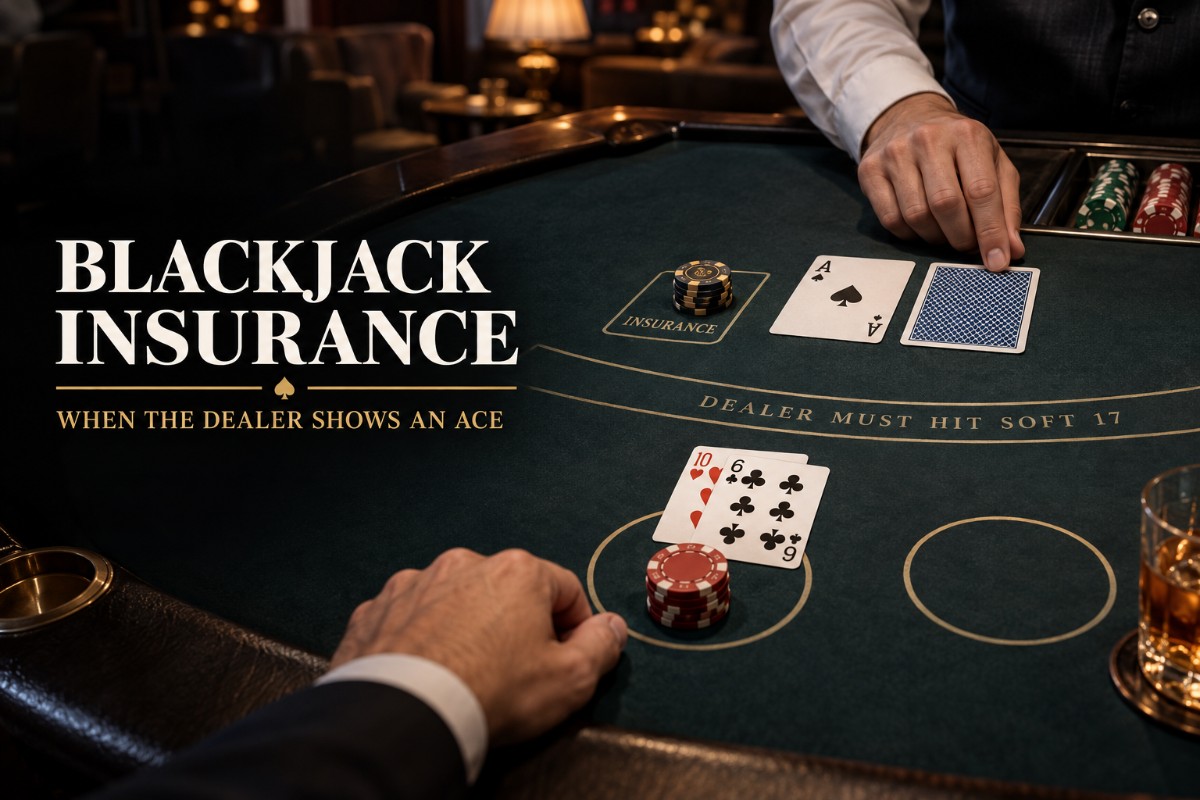
Blackjack insurance is an optional wager offered when the dealer shows an ace. It does not protect your original hand in the ordinary sense. Instead, it is a separate bet on whether the dealer’s hidden card has a value of ten, which would complete a natural 21. The offer can look reassuring when a strong player hand suddenly faces a threatening dealer ace, but the price and probability need to be understood before adding more money to the table.
In standard forms of the game, the insurance bet can usually be no more than half of the original stake and commonly pays 2 to 1 when the dealer has blackjack. If the hidden card is not worth ten, that side wager loses and the main hand continues under the normal rules. This makes it a distinct blackjack side bet, not a change to the value of the cards already in your hand.
How blackjack insurance actually works
When the dealer’s face-up card is an ace, players may be offered blackjack insurance before the dealer checks the hole card or before play continues, depending on the game format. A player who accepts places a separate wager. If the dealer’s hidden card is a 10, jack, queen or king, the dealer has a natural 21 and the insurance portion wins at the stated payout.
For a simple example, suppose your main wager is S$20. A table allowing insurance up to half the main stake would let you place S$10 on the insurance bet. If a dealer blackjack is confirmed and the insurance payout is 2 to 1, the S$10 side wager produces S$20 in winnings, plus the returned insurance stake. What happens to the original S$20 depends on your own hand and the table rules.
If the dealer does not have a ten-value card underneath the ace, the insurance portion is lost. The round then continues. That separation is important because the blackjack side bet can lose even when your main hand later wins, and it can win when the main wager loses.
Why the dealer ace triggers the offer
An ace is the only up-card that can combine with any ten-value card to make an immediate natural 21. That is why the dealer ace creates the insurance opportunity. The side wager is effectively asking one narrow question: is the face-down card worth ten?
A standard deck contains more non-ten-value cards than ten-value cards. That matters because a 2 to 1 payout requires the winning event to occur often enough to justify the price. Without extra information about the remaining shoe, ordinary basic strategy generally does not treat blackjack insurance as a favourable routine choice.
Seeing an ace across the table can feel threatening, but the correct question is whether the available payout matches the actual chance of the hidden card being worth ten.
What happens to your main blackjack hand
The main wager and the insurance portion are settled separately. With an ordinary hand, a dealer blackjack normally defeats the main wager while a winning insurance wager is paid under the table rules. If the dealer does not have blackjack, the side wager is collected and play continues.
If you already have a natural 21 when the dealer shows an ace, some tables may offer “even money”. It can lock in an even-money result rather than waiting to see whether a dealer blackjack creates a push. Check the displayed rules because procedures can vary.
The important point is that blackjack insurance does not improve the total of your hand. It only creates another wager tied to the possibility of a dealer blackjack. A 20 remains a 20, a 16 remains a 16, and your later hit, stand, split or double decision still follows the rules of the main game.
Why insurance is not really protection
The name can be misleading. At the blackjack table, the insurance bet is another wager with its own winning and losing condition. It does not cancel the original hand or guarantee that the round finishes without a loss. Treat the insurance bet as a separate decision rather than protection for the hand.
Consider a player holding 18. If the hidden card is not worth ten, the side wager loses immediately, but the 18 must still compete against the dealer’s final hand. You could therefore lose the blackjack side bet and then lose the main wager as well. The word “insurance” should never replace an understanding of the underlying mathematics.
For a broader explanation of optional wagers, the casino side bets guide shows why separate bets should be evaluated by their own rules, payouts and probabilities rather than by how attractive their names sound.
The simple maths behind the decision
A 2 to 1 payout means a successful wager returns two units of profit for every one unit staked. For that payout to be fair before considering card information, the hidden ten-value card would need to appear one time in three. In a fresh deck, ten-value cards account for 16 of 52 cards, which is less than one third.
After visible cards are removed, the exact proportion changes. Advanced card-counting discussions can therefore treat the decision differently. For an ordinary player who is not tracking deck composition accurately, the simpler lesson is not to assume the dealer ace makes the wager worthwhile. Probability also does not improve because your main stake is large or previous rounds were losses.
Insurance and even money are closely connected
Players holding a natural 21 may hear the dealer offer even money when an ace is showing. Accepting it normally produces a 1 to 1 win immediately instead of the usual higher blackjack payout, depending on the table rules. Mathematically, this is closely connected to taking blackjack insurance while holding a natural.
With a S$40 main stake and a 3 to 2 natural payout, declining even money can produce S$60 profit when no dealer blackjack appears, while a matching natural generally pushes. Even money sacrifices that upside for a fixed S$40 profit.
That trade-off can feel safer, but it still comes from the same underlying question about the hidden card. The insurance bet and even-money offer should therefore be evaluated as pricing decisions, not as ways to remove uncertainty from the game.
Common mistakes players make with the side wager
One common mistake is taking the wager automatically whenever the dealer shows an ace. The ace showing is what makes the wager available, but availability does not prove value. The payout and composition of the remaining cards are what matter.
Another mistake is taking it because the main hand looks strong. A player with 19 or 20 may feel there is more to “protect”, yet the probability of the hidden card does not improve merely because the player’s total is high. The blackjack side bet remains a separate proposition.
A third mistake is increasing the optional stake after previous losses. If the last two rounds ended badly, that does not make a ten-value hole card due. When using Gembet, check the current table rules and stake limits before acting, and keep the optional wager separate from any attempt to recover earlier losses.
How to handle the decision at the table
Start by reading the table rules. Confirm the maximum insurance amount, payout, dealer check procedure and treatment of even money. These details can differ between variants.
Next, keep the decision separate from the rest of the hand. Do not let a threatening up-card rush you into an extra wager. If you are using standard basic strategy without reliable information about deck composition, blackjack insurance is generally treated as an optional wager to decline rather than a routine defensive move.
After the dealer check, return your attention to the main hand. Decisions such as hitting, standing or doubling should be based on the hand total and the applicable game rules. The blackjack double down guide is useful when you want to understand one of those main-hand choices separately from insurance.
Keeping the decision disciplined
The best way to approach blackjack insurance is to strip away the reassuring name and view it as a priced wager on the dealer’s hidden card. A dealer ace creates the offer, but it does not make the outcome certain. The wager wins only when the hole card completes the required natural.
For casual players, that means checking the payout, understanding that the optional stake can be lost independently, and avoiding decisions based on fear of the dealer’s hand. A blackjack side bet should never become an automatic reaction to one visible card.
Whether you are staking S$10 or S$100, keep the main wager and the optional wager mentally separate. Record them separately if you track results, and do not use insurance as a tool for chasing losses. Clear rules and consistent stakes are more useful than turning every threatening up-card into another bet.
Experience the real deal with SG's top Live Dealers. Play Baccarat, Roulette & more.

