


Baccarat Tie Bet Strategy Essential Guide to a High-Payout Side Wager
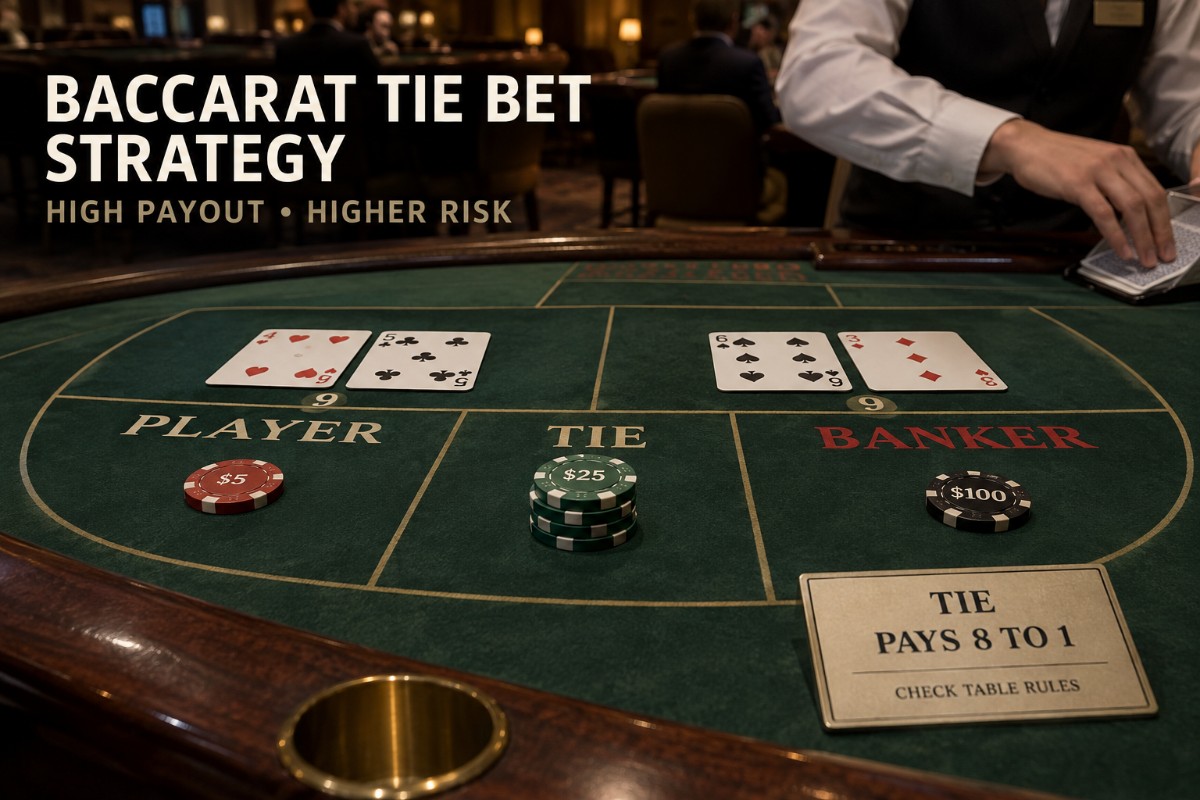
Baccarat tie bet strategy begins with understanding that the Tie wager is fundamentally different from betting Player or Banker. Instead of choosing which side will finish closer to nine, the Tie bet predicts that both final hands will have exactly the same total. That narrower requirement is why the payout is much larger than the two main wagers.
The higher return can make the option look attractive, but baccarat tie payout figures should never be considered without the underlying tie probability. A useful approach compares how often the result occurs, what the table pays, and how much of the session budget is being committed to a low-frequency side wager.
How a Tie bet works
In standard baccarat, Player and Banker are dealt according to fixed drawing rules. The final totals are compared after any required third cards are drawn. If both sides finish on the same total, the round is a tie.
A Tie bet wins only when that exact condition occurs. If Player wins or Banker wins, the wager loses. On many traditional tables, the tie wager pays either 8:1 or 9:1 depending on the specific version and operator rules.
For a refresher on how baccarat totals are calculated, see the baccarat card values guide. When using Gembet, check the current help panel before betting because the baccarat tie payout and side-bet rules can vary between tables.
Why the payout is much higher than Player or Banker
Player and Banker wagers cover broad opposing outcomes, while the Tie bet needs both hands to finish on the same final total. That is a much narrower event, so the table compensates with a larger quoted return.
This is the central trade-off behind baccarat tie bet strategy. A large payout does not mean the wager is more favourable. It usually means the winning condition is less common.
For example, a standard 8:1 tie payout means a successful S$5 wager produces S$40 in profit plus the returned S$5 stake. The size of that return can be appealing, but most rounds still finish with either Player or Banker winning.
What the tie probability looks like
Under standard eight-deck baccarat rules, authoritative mathematical analysis puts the probability of a tie at roughly 9.5%. That means the result occurs far less often than either of the two main outcomes.
Expressed another way, tie probability is approximately one result in every ten or eleven rounds on average over a very large sample. That does not mean a tie is guaranteed after ten non-tie rounds, or that two ties cannot occur close together.
A strong baccarat tie bet strategy treats the long-run probability as a mathematical reference, not as a countdown to the next result.
Why 8:1 and 9:1 payouts matter
Small differences in baccarat tie payout can make a significant difference to the house edge. Wizard of Odds calculates that an 8:1 tie payout carries a much larger house advantage than either standard Banker or Player wagering. A 9:1 payout is better for the player, but the wager still remains considerably more expensive mathematically than the two main sides under common rules.
This is why the number printed on the table should be checked rather than assuming every baccarat game uses the same terms. Two tables that look nearly identical can offer different side-bet economics.
The headline payout should therefore be evaluated alongside the tie probability rather than in isolation.
Does a previous tie make another one less likely?
No. A recent tie does not prevent another tie from occurring on the next hand. Likewise, a long stretch without a tie does not force the next round to produce one.
This is one of the most common errors surrounding a Tie bet. Players may watch a roadmap and conclude that the absence of ties means one is due, or that several recent ties make another unlikely. Neither conclusion follows simply from the sequence.
A disciplined baccarat tie bet strategy treats past results as history rather than a schedule the shoe must correct.
Why roadmaps can make ties feel more predictable
Baccarat roadmaps visually record Banker, Player and tie results. Because ties often appear as small marks layered onto an existing road, they can stand out when several occur close together or when none have appeared for a long period.
That visual pattern can create the impression that the next tie can be anticipated. The roadmap does not reveal the future order of the remaining cards. It only organises completed results.
The baccarat roadmaps guide explains how these displays work and why they should not be treated as prediction systems.
Why Player and Banker remain separate decisions
The existence of a Tie bet does not change the basic Player and Banker settlement. If you place only a Player wager and the round ties, the standard result on many tables is a push, meaning the main wager is returned. The same commonly applies to a standard Banker wager.
That is different from placing a separate Tie wager. The tie side bet has its own stake, payout and house edge.
One useful baccarat tie bet strategy habit is to think of every chip separately. Adding a S$2 Tie bet to a S$10 Banker wager means S$12 is exposed across two different conditions, not one combined wager.
Why adding a small Tie bet every round adds up
A side bet can feel harmless when the stake is small. For example, adding S$2 to every baccarat hand may not seem significant compared with a S$10 main wager.
Over fifty rounds, however, those S$2 additions represent S$100 of total tie wagering. Because the Tie bet carries a relatively high house edge under common payout structures, repeated exposure can materially change the cost of the session.
Good bankroll management looks at cumulative wagering rather than only the size of one chip.
Should you increase the Tie bet after long gaps?
A long sequence without a tie can make the next one feel overdue. Increasing the stake after that gap is a form of chasing a pattern rather than responding to new information.
The tie probability does not rise simply because several recent hands ended with Player or Banker. The shoe may still produce another long gap, or it may produce a cluster of ties. Short-term sequences can vary considerably.
Baccarat tie bet strategy should therefore avoid progression systems that increase the stake solely because the result has been absent.
What about betting both main side and Tie?
Some players place a main wager and a Tie bet together. This creates two separate paths to a return, but it also increases the total stake. The side wager does not make the main wager safer or change the cards dealt.
For example, S$10 on Player plus S$2 on Tie creates S$12 of total exposure. If Banker wins, both bets lose. If Player wins, the main wager can win while the side bet loses. If the round ties, the side wager can win while the Player bet may push under standard rules.
The combined structure should therefore be judged by total exposure rather than by the impression that the Tie bet offers insurance.
Why variant rules need to be checked
Modern baccarat tables can include alternative commission structures, special side bets and modified payouts. Some variants may also handle ties or bonus conditions differently from classic baccarat.
That makes it important to read the table-specific rules before applying advice from another game. The same visual labels do not always guarantee identical payout tables.
A practical baccarat tie bet strategy begins with confirming the exact tie payout, then comparing it with the table’s main Banker and Player options.
A clearer way to think about the Tie bet
Baccarat tie bet strategy works best when the wager is treated as a high-payout, low-frequency side option rather than a prediction opportunity. Check the baccarat tie payout, understand the tie probability, and decide whether the extra risk fits the session budget before placing the chip.
Do not increase the stake because a tie feels due, and do not assume roadmap patterns change the chance of the next result. Player and Banker remain separate main wagers with different long-run characteristics.
Baccarat tie bet strategy cannot predict when equal totals will occur. It can, however, make the trade-off much clearer: the larger potential payout comes with a narrower winning condition and, under common rules, a substantially higher house edge than the main baccarat bets.
Experience the real deal with SG's top Live Dealers. Play Baccarat, Roulette & more.

