


Baccarat Tie Bet Smart Guide to Payouts and Real Risk
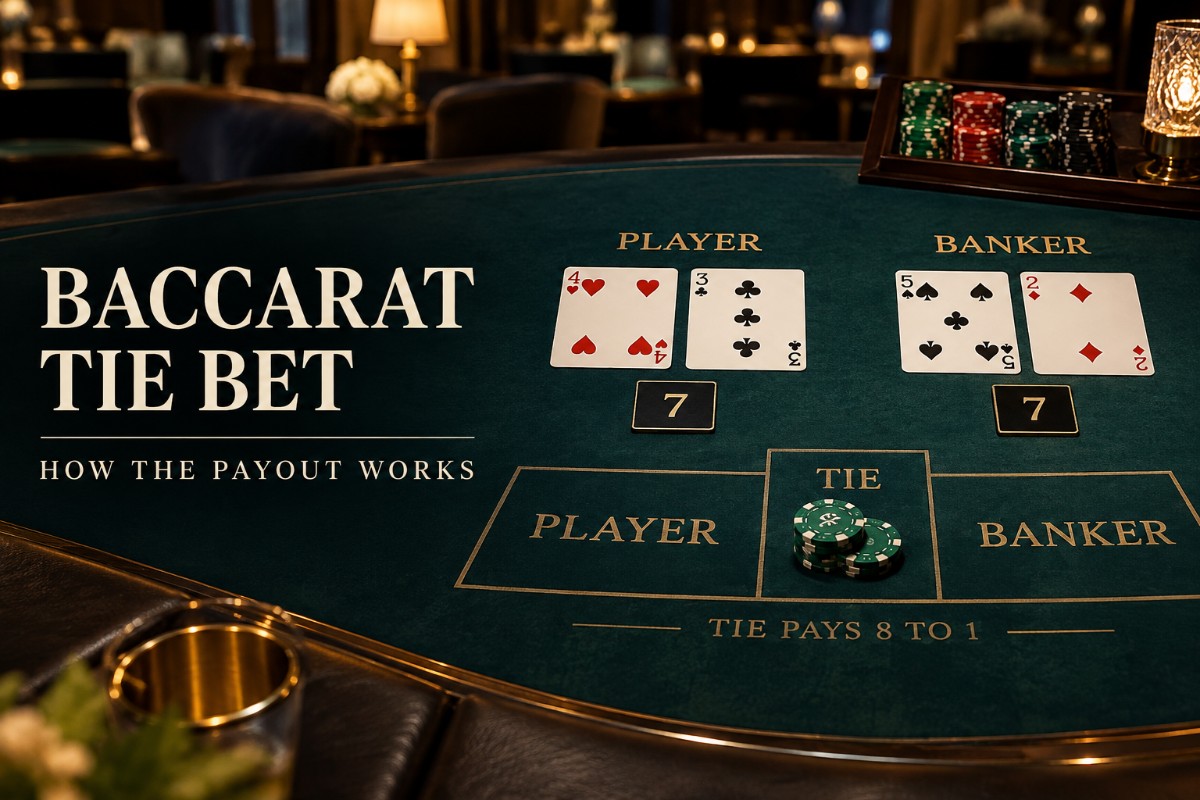
A baccarat tie bet is a wager that wins when the Player and Banker hands finish with the same point total after the normal drawing rules have been applied. It can look attractive because the posted return is much larger than the standard Player or Banker selection, but the higher reward reflects a much less frequent result. Understanding that trade-off is more useful than focusing on the headline payout alone.
In many conventional games, the tie wager pays 8 to 1, although individual tables and variants can use different paytables. If the hands do not finish level, the tie selection loses. Meanwhile, ordinary Player and Banker bets usually push when the two hands tie. That difference is central to understanding how the market works.
How the tie result is decided
Baccarat does not compare individual card ranks in the way poker does. Each hand receives a point total under baccarat rules, with tens and face cards worth zero and only the last digit of totals above nine counting. The two main hands can receive a third card according to fixed drawing rules. Once dealing is complete, the final totals are compared.
If both sides finish on the same total, the baccarat tie bet wins. A 6-6 result is a tie, as is 0-0, 7-7 or any other equal final total. The number of cards in each hand does not need to match for the standard tie outcome unless a specific variant or side wager says otherwise.
Why the payout is higher than Player or Banker
The standard baccarat payout for a tie is often much larger than the return on Player or Banker because ties occur less often. Current approved live baccarat rules commonly list an 8-to-1 payment for a conventional tie wager, while other variants can use different structures.
A higher payout does not mean better probability. The price simply compensates for an outcome that appears less frequently. If you stake S$10 on an 8-to-1 tie and it wins, the profit would be S$80, with the original stake also returned. If the hands do not tie, the S$10 stake is lost.
That makes the baccarat side bet very different from simply choosing which main hand will finish higher. The larger return comes with a narrower winning condition.
What happens to Player and Banker bets on a tie
For conventional baccarat, a tie normally causes standard bets on the two main hands to push rather than lose. The original main-bet stake is returned. The separate tie selection, by contrast, wins if the final totals are equal.
New players sometimes assume every wager settles the same way on a tie. It does not. A main Player or Banker selection and a tie wager have different conditions and paytables.
Check the rules displayed for the exact game. Some no-commission or specialty baccarat variants alter Banker payouts, and some games add extra tie-related options. The normal push treatment of the main bets and the separate tie payment should be confirmed from the table rules rather than assumed from another version.
Why an 8-to-1 return does not remove the house edge
A common mistake is seeing an 8-to-1 baccarat payout and assuming a few wins can easily offset several losses. The missing piece is frequency. An outcome that pays more can still have an unfavourable expected return if the payment is lower than the true fair price for the probability involved.
In standard multi-deck baccarat, the tie option generally carries a higher house edge than the main wagers when it pays 8 to 1. That does not stop a tie occurring next; it means the long-run pricing is less favourable.
The baccarat tie bet should therefore be treated as a high-variance optional wager rather than a shortcut to larger returns. One winning hand does not change future probability. A second baccarat tie bet is still a new decision, and every baccarat tie bet should be judged on the current paytable.
Do previous ties make another tie more likely?
No simple streak makes the next round due. Baccarat roadmaps can record previous outcomes, but they do not force the next deal to repeat or reverse a pattern. A sequence with no ties does not mean a tie must arrive soon, and several recent ties do not prove another is coming.
This matters because the baccarat side bet can tempt players to increase stakes after a long gap. That confuses recorded history with a predictive signal. Past outcomes do not make a tie due.
If you want to review how card totals are calculated before assessing tie outcomes, the baccarat card values guide explains how cards contribute to the final total. That foundation is more useful than trying to interpret a streak as a guarantee.
How different paytables change the decision
Not every table uses the same baccarat payout. Conventional live baccarat often lists 8 to 1 for a tie, while some variants may pay differently or split tie results into additional categories. Certain baccarat variants can also use separate payments for different types of tied hands.
That means the word tie on a layout is not enough by itself. Read the actual paytable. An 8-to-1 standard tie wager and a specialty tie option with tiered payouts are not mathematically identical products. The baccarat payout must match the specific table.
Using sensible stake sizes on a volatile outcome
Because a baccarat tie bet wins less frequently than either main side, losing runs can be longer. That makes stake control especially important. If you normally risk S$20 on a main hand, automatically placing the same amount on a less frequent outcome can create much larger swings than expected.
Decide in advance whether optional wagers belong in your session budget. If they do, keep them small enough that several losses do not force a change in your plan.
When using Gembet, check the current minimum, maximum and paytable shown for the exact baccarat game before confirming a wager. The displayed table rules should take priority over assumptions based on another game or provider.
Tie betting compared with choosing a main hand
Choosing between Player and Banker asks which hand will finish with the higher total. Betting on a tie asks whether neither side will finish higher. Those are different predictions and should not be mixed together when reviewing results.
A player seeking lower volatility may prefer the main wagers. Anyone choosing the tie should understand that the larger return comes with a lower hit rate and typically a less favourable mathematical profile.
The Banker vs Player baccarat guide can help separate the two main selections from the tie option. Comparing the three outcomes by rules and price is more useful than choosing whichever one has the largest number beside it.
Common mistakes with the tie option
One mistake is treating a baccarat side bet as a recovery tool after losses on the main hands. A larger potential payout can make this tempting, but changing to a rarer outcome does not erase previous losses or improve the next hand.
Another mistake is assuming every tie pays the same amount. Always read the table because different variants can change the paytable. A third mistake is confusing a push on the main bets with a winning tie selection. They are separate settlements.
Finally, avoid increasing a tie wager because a roadmap has gone many rounds without one. The absence of a recent tie is not evidence that the next deal must produce equal totals. Treat each tie wager as a separate risk decision.
A practical checklist before placing the bet
Before making a baccarat tie bet, confirm the exact payment, the deck and variant rules, and whether you are looking at the standard tie or a specialty version. Understand what happens to the main bets if the round ties and keep the optional stake separate from your normal Player or Banker amount.
Check the baccarat payout rather than relying on memory from another table. If the displayed return differs, the value of the wager changes.
Most importantly, decide the stake before the cards are dealt. Do not let previous outcomes, a long gap between ties or a recent winning streak change the amount impulsively.
Keeping the tie bet in perspective
The baccarat tie bet is easy to understand once the settlement is separated from the main game: equal final totals make it win, while unequal totals make it lose. Its larger return reflects a less common result, not a hidden advantage.
For players comparing Player and Banker with the tie option, the key differences are probability, payout and volatility. A clear understanding of those three factors is more useful than following patterns on a scoreboard.
If you decide to use the baccarat side bet, treat it as an optional part of the game, keep the stake controlled and judge it by the actual paytable. Any baccarat side bet should be grounded in rules and pricing rather than the belief that an outcome is overdue.
Experience the real deal with SG's top Live Dealers. Play Baccarat, Roulette & more.

